For decades, nutrition guidance has focused primarily on macronutrients. Calories, protein intake, fats, and carbohydrates have dominated public health messaging, diet trends, and food labeling. Micronutrients were often treated as secondary, addressed mainly through recommended daily allowances designed to prevent deficiency diseases rather than optimize long-term health. That hierarchy is now beginning to shift.
A growing body of research is drawing attention to functional minerals, a category of essential minerals whose role extends beyond basic deficiency prevention into metabolic regulation, immune resilience, and disease risk modulation. This shift reflects a broader trend in preventive nutrition, one that emphasizes physiological function, cellular efficiency, and long-term resilience rather than short-term nutrient adequacy.
The rise of functional minerals signals a change in how nutrition science understands the relationship between diet and health. It suggests that minerals are not passive dietary components, but active participants in complex biological systems.
What Are Functional Minerals?
Functional minerals are minerals that play direct, regulatory roles in key physiological processes. Unlike the traditional view that minerals simply support structural functions such as bone formation, the functional framework highlights their involvement in enzymatic activity, hormonal signaling, mitochondrial energy production, and cellular communication.
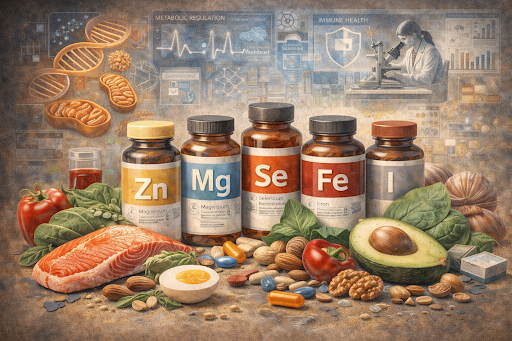
Examples commonly discussed in this context include magnesium, zinc, selenium, iodine, iron, and chromium. These minerals act as cofactors for hundreds of enzymes and are essential for processes such as glucose metabolism, antioxidant defense, thyroid function, and immune regulation.
What distinguishes functional minerals from conventional micronutrient discussions is not the minerals themselves, but how they are conceptualized. The focus shifts from avoiding deficiency to supporting optimal function across systems.
Why Interest in Functional Minerals Is Growing
Several converging trends have driven renewed interest in functional minerals. One is the rising prevalence of chronic, non-communicable diseases such as metabolic syndrome, cardiovascular disease, and autoimmune conditions. These disorders often develop in the absence of overt nutrient deficiencies, suggesting that traditional adequacy models may be insufficient.
Another factor is increased awareness of subclinical insufficiency. Population-level nutrition surveys consistently show that large segments of the population fail to meet optimal intake levels for minerals like magnesium and zinc, even when calorie intake is adequate. These gaps may not cause immediate disease but can impair metabolic efficiency and stress resilience over time.
Research summarized by the National Institutes of Health has highlighted the role of mineral cofactors in insulin signaling, mitochondrial function, and inflammatory regulation, reinforcing the idea that mineral status influences long-term health trajectories.
Functional Minerals and Metabolic Regulation
One of the most active areas of research involving functional minerals is metabolic health. Minerals such as magnesium and chromium play important roles in glucose metabolism and insulin sensitivity. Magnesium is required for insulin receptor activity and cellular glucose transport, while chromium influences insulin signaling efficiency.
When mineral availability is insufficient, these pathways become less efficient. Over time, metabolic strain increases, contributing to insulin resistance and impaired energy regulation. This helps explain why mineral status is increasingly discussed alongside diet composition and physical activity in metabolic health research.
The American Journal of Clinical Nutrition has published multiple analyses linking mineral intake patterns with metabolic outcomes, suggesting that mineral sufficiency may act as a moderating factor in disease risk.
Immune Function and Inflammatory Balance
Functional minerals are also central to immune regulation. Zinc, selenium, and iron are essential for immune cell development, signaling, and antioxidant defense. Selenium, in particular, supports enzymes that protect cells from oxidative damage during immune activation.
Low mineral availability can skew immune responses toward chronic inflammation or impaired pathogen defense. This imbalance has implications not only for infection risk but also for inflammatory conditions and recovery capacity.
As preventive nutrition shifts toward immune resilience rather than reactive treatment, functional minerals are increasingly recognized as foundational inputs rather than optional supplements.
The Impact of Modern Food Systems
Another reason functional minerals are gaining attention is the growing concern about mineral availability in modern diets. Changes in agricultural practices, food processing, and dietary patterns have altered the mineral content of commonly consumed foods.
Soil depletion, monocropping, and reliance on synthetic fertilizers can reduce the mineral density of crops. Processing further strips minerals from foods, particularly in refined grains and ultra-processed products. As a result, even individuals consuming sufficient calories may fail to obtain adequate mineral support.
The Food and Agriculture Organization of the United Nations has raised concerns about declining soil mineral content and its implications for global nutrition, highlighting the systemic nature of the issue.
Functional Minerals vs. Fortification
Food fortification has long been used to address nutrient deficiencies, but the functional mineral framework raises questions about its limitations. Fortification typically targets a narrow set of nutrients and does not replicate the complexity of mineral interactions found in whole foods.
Minerals do not act in isolation. Their absorption and utilization depend on ratios, cofactors, and overall dietary context. For example, excess calcium can interfere with magnesium absorption, while zinc and copper must be balanced for optimal immune function.
Preventive nutrition trends increasingly emphasize mineral balance and bioavailability rather than isolated nutrient targets, reflecting a more systems-oriented understanding of nutrition.
Personalized Nutrition and Mineral Needs
Another driver of interest in functional minerals is the rise of personalized nutrition. Genetic variation, lifestyle factors, and metabolic health all influence mineral requirements. Stress, physical activity, and chronic illness can increase demand for certain minerals, while digestive function affects absorption.
The heterogeneity of individual needs renders blanket dietary recommendations for mineral intake ineffective, underscoring the necessity of a personalized approach. Consequently, research on functional minerals is shifting its focus from broad population averages to the specific requirements of physiological states and life stages. Resources dedicated to metabolic and preventive health, such as those found on Dr. Berg’s, frequently highlight the crucial role of mineral balance and micronutrient density within a holistic nutritional framework.
Preventive Nutrition and Long-Term Health
Preventive nutrition aims to reduce disease risk by supporting physiological resilience before dysfunction becomes clinically apparent. Within this framework, functional minerals are increasingly viewed as upstream regulators rather than downstream fixes.
Rather than waiting for symptoms to appear, the goal is to maintain enzymatic efficiency, hormonal balance, and cellular energy production across the lifespan. Minerals are essential to all of these processes, making their role in prevention difficult to ignore.
This perspective aligns with a broader shift in health care from reactive treatment to risk reduction and system maintenance.
The Commercial and Cultural Shift
The rise of functional minerals is also reflected in consumer behavior and product development. Mineral-focused supplements, mineral-rich waters, and functional foods have gained popularity, often marketed around energy, stress support, and immune health.
While commercialization carries risks of oversimplification, it also reflects growing public awareness that micronutrients matter beyond basic deficiency prevention. The challenge for nutrition science is to guide this interest with evidence-based frameworks rather than isolated claims.
Rethinking Minerals in Nutrition Science
The renewed focus on functional minerals represents a recalibration rather than a revolution. Minerals have always been essential. What has changed is the recognition of how deeply they influence complex biological systems and long-term health outcomes.
By moving beyond deficiency models, nutrition science is beginning to address the subtle, cumulative effects of mineral insufficiency that shape metabolic health, immune resilience, and aging processes.
The rise of functional minerals in preventive nutrition reflects a broader shift toward systems thinking in health science. As chronic disease patterns continue to evolve, attention is moving upstream toward foundational inputs that support cellular function over time.
Functional minerals offer a lens through which nutrition can be understood not just as fuel, but as information. They influence how the body interprets stress, manages energy, and maintains balance across systems.
As research continues to clarify their roles, functional minerals are likely to remain central to preventive nutrition strategies. Their growing prominence suggests a future in which nutrition is measured not only by what it prevents, but by what it enables: resilience, adaptability, and long-term metabolic health.