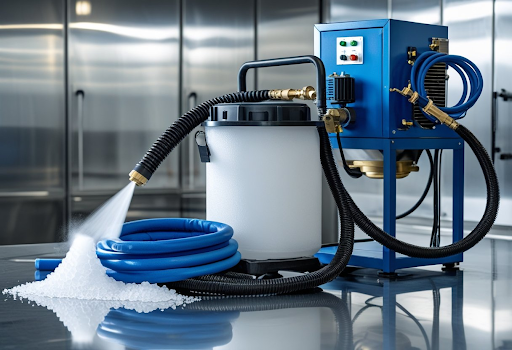
Industrial cleaning operations across many sectors face challenges related to residue buildup, maintenance interruptions, and the need to protect sensitive equipment surfaces. In these environments, dry ice blasting is used as a non-abrasive, dry cleaning method that avoids the use of water or chemical agents. Nu-Ice® Dry Ice Blasting designs and manufactures industrial dry ice blasting equipment and accessories intended to support controlled cleaning processes in demanding applications. Among its air management accessories is the Command Air® Aftercooler, a dry ice blasting air cooler designed to condition compressed air by reducing heat and moisture before it enters the blasting system, supporting stable operation across a range of industrial conditions.
Dry ice blasting is a surface-cleaning method in which solid carbon dioxide (CO₂) pellets are propelled toward a surface using compressed air. When the pellets contact the surface, they sublimate—changing directly from a solid to a gas—which helps separate contaminants from the substrate without the use of abrasive media or liquids. Because the dry ice does not melt or leave residue, the process produces no secondary blasting waste and is used in industrial applications where dry, non-abrasive cleaning is required.
Kinetic Impact – In dry ice blasting, compressed air accelerates dry ice pellets through a nozzle toward the target surface. The controlled impact of the pellets helps loosen surface buildup without abrasive contact, supporting cleaning on sensitive materials and components.
Thermal Effect – Dry ice is extremely cold, and contact with warmer surfaces creates a rapid temperature change at the point of impact. This temperature differential can weaken the bond between contaminants and the surface, assisting in their removal during blasting.
Sublimation Expansion – Upon impact, dry ice pellets sublimate from a solid directly into carbon dioxide gas. This phase change occurs at the surface interface and contributes to lifting contaminants away without leaving blasting media behind.
Together, these physical principles describe how dry ice blasting functions as a non-abrasive, dry cleaning method used with Nu-Ice® dry ice blasting equipment across a range of industrial maintenance and surface preparation applications.
A dry ice blasting machine consists of several core components that work together during operation. An air compressor supplies compressed air to carry dry ice pellets through the system. A dry ice hopper stores and feeds solid carbon dioxide (CO₂) pellets, while a metering system regulates pellet delivery into the airflow. The hose and nozzle assembly directs the compressed air and dry ice stream toward the surface being cleaned. These components enable controlled pellet acceleration and application without introducing water, chemical cleaning agents, or abrasive media into the process.
Nu-Ice Age, Inc. is a veteran-owned manufacturer based in Jackson, Michigan, founded in 2007. The company designs and manufactures the Commando® series of dry ice blasting machines and related accessories in the United States. Nu-Ice focuses on producing equipment intended for dry, non-abrasive cleaning across a variety of industrial environments, serving sectors such as manufacturing, food processing, restoration, and other industrial maintenance applications. Nu-Ice products are available through direct sales, distributor channels, and rental partners.
Nu-Ice® dry ice blasters are designed to operate with a blasting gun compatible with interchangeable nozzle options, allowing operators to adjust blast patterns based on surface type and cleaning requirements. Available nozzle configurations support different spray patterns and coverage areas. Nu-Ice systems are designed to be used with moisture management components, such as moisture separators, to help reduce water in the compressed air supply before it enters the blasting stream. Air conditioning accessories, including the Command Air® Aftercooler, are offered within the Nu-Ice product line to help condition compressed air prior to blasting. Nu-Ice equipment also incorporates adjustable blast pressure and pellet feed controls and utilizes the BlitzFeed® freezeless dry ice delivery system to support consistent pellet flow during operation.
The Commando® 55 Dry Ice Blaster is designed for industrial cleaning applications and features a dry ice hopper with a capacity of approximately 55 lbs (25 kg). The machine measures about 33.25 inches in length, 23 inches in width, and 39 inches in height, with an overall weight of roughly 234 lbs. It is engineered to operate across a range of compressed air pressures, typically from approximately 60 to 250 psi, with airflow requirements that vary depending on application and configuration. Dry ice consumption can reach up to around 425 lbs per hour. The system includes adjustable blast pressure and pellet feed controls and is designed to integrate with standard industrial air supplies using a 1-inch JIC compressed air connection. These specifications reflect a machine intended for use in demanding industrial environments.
Preparation and Setup – Before operation, position the Commando® dry ice blaster near a compatible compressed air source and verify that the air compressor meets the pressure and airflow requirements for the application. Load dry ice pellets into the hopper, inspect hoses and fittings, and confirm that all connections are secure. Operators should have appropriate personal protective equipment available prior to use.
Safety Requirements – Operators should follow all manufacturer-provided safety instructions and wear suitable personal protective equipment (PPE), including eye protection, gloves, and hearing protection. Adequate ventilation should be provided to manage carbon dioxide gas during operation, and the work area should remain clear of bystanders.
Typical Workflow Steps – After completing setup and safety checks, start the air compressor and adjust blast pressure and pellet feed settings as required. Direct the blasting gun toward the surface being cleaned and move the nozzle in a controlled, even manner across the area. Airflow and pellet delivery may be adjusted during operation based on surface conditions and contamination levels.
Nu-Ice® dry ice blasting systems are used across a range of industrial and commercial environments where dry, non-abrasive cleaning methods are required. In manufacturing and production settings, dry ice blasting is applied to clean equipment such as molds, tooling, weld cells, and conveyor systems without the use of abrasive media or liquid cleaners. In food processing facilities, dry ice blasting is used on processing equipment, packaging machinery, and plant surfaces where dry, chemical-free cleaning methods are preferred.
Dry ice blasting is also used in restoration and surface maintenance applications involving brick, stone, and other sensitive materials, where abrasive methods may not be appropriate. Additional applications include automotive and aerospace environments for cleaning tooling and production components, as well as electrical, plastics, packaging, and other industrial settings where moisture or abrasive media may be unsuitable.
Dry ice blasting produces no secondary blasting waste because the dry ice pellets sublimate on contact, leaving only the removed contaminants behind for collection or disposal. The process is non-abrasive and does not introduce water or chemical cleaning agents into the work area. When planning operations, considerations include providing adequate ventilation to manage carbon dioxide gas and ensuring the use of compatible compressed air supplies and appropriate personal protective equipment (PPE).
The Command Air® Aftercooler is offered within the Nu-Ice product line as a dry ice blasting air cooler designed to condition compressed air by reducing heat and moisture before it enters the blasting system. This type of air conditioning accessory is used to help manage air quality prior to blasting, particularly in environments where compressed air moisture may be a concern.
Nu-Ice® offers a range of optional accessories to support different dry ice blasting applications. Available components include interchangeable nozzles designed for varied spray patterns, blasting and air supply hoses in multiple lengths and configurations, and air management accessories such as moisture separators and aftercoolers. Additional accessories, including protective covers and ice handling tools, are also available. Routine inspection, proper storage, and maintenance of system components are recommended to support consistent operation.
Frequently Asked Questions (FAQs)
What is dry ice blasting?
Dry ice blasting is a cleaning process that uses compressed air to propel solid carbon dioxide (CO₂) pellets toward a surface. Upon impact, the pellets sublimate—changing directly from a solid to a gas—helping remove contaminants without introducing water, abrasive media, or chemical cleaning agents.
How do I know if my equipment is compatible?
Compressed air systems should meet the pressure and airflow requirements specified by the dry ice blasting equipment manufacturer. Operators should also confirm that hoses, blasting guns, and nozzles are compatible with the machine’s connections and size specifications.
What safety considerations should I follow?
Operators should wear appropriate personal protective equipment (PPE), including eye protection, hearing protection, and gloves. Adequate ventilation is required to manage carbon dioxide gas during operation, and work areas should be secured before blasting.
What infrastructure is required?
Operation requires a compatible industrial air compressor, a supply of dry ice pellets with proper storage, sufficient workspace with ventilation, and compatible hoses and blasting gun assemblies.
How does dry ice blasting compare to abrasive methods?
Dry ice blasting uses solid CO₂ pellets propelled by compressed air, while abrasive methods rely on media such as sand or grit. The methods differ in media type and waste handling; dry ice pellets sublimate on contact, leaving only the removed contaminants behind.
What are the environmental considerations?
Dry ice blasting produces no secondary blasting waste because the pellets sublimate upon impact. Proper ventilation is important to manage carbon dioxide gas in enclosed or confined spaces.
The Command Air® Aftercooler is part of Nu-Ice’s range of air management accessories for dry ice blasting systems. It is designed to condition compressed air by reducing heat and moisture before the air enters the blasting system, addressing common compressed air challenges in industrial environments. Offered alongside Nu-Ice® dry ice blasting machines and accessories, the Command Air® Aftercooler is intended for use in applications where managing air temperature and moisture is an important operational consideration.