In today’s search landscape, many businesses face persistent challenges such as stagnant rankings, rising agency costs, and ongoing algorithm volatility that can quickly erode short-term gains. As a result, the need for a long term SEO strategy has become increasingly important for maintaining consistent visibility. G-Stacker introduces an alternative approach through its Autonomous SEO Property Stacking platform, which focuses on building interconnected digital assets designed to strengthen topical relevance and authority over time. Rather than relying on manual backlink outreach or low-quality AI-generated content, property stacking emphasizes structured ecosystem development as a pathway toward more sustainable SEO growth and scalable authority building SEO practices.
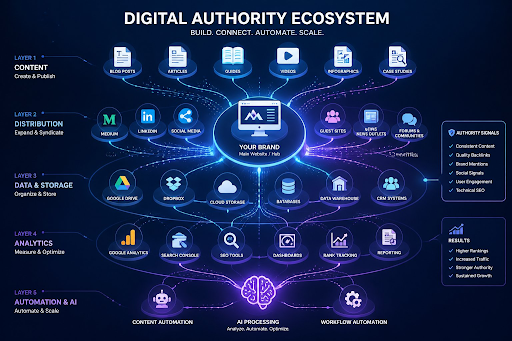
Google stacking is a method of creating and connecting multiple web-based assets—often within trusted platforms—to strengthen a site’s overall authority and relevance. G-Stacker applies this concept through an “Authority Ecosystem,” where interconnected properties are generated and structured to reinforce topical signals across the web. The platform introduces one-click automation to streamline the creation and linking of these assets, reducing the need for manual setup. Within this system, content is organized around specific topics to establish contextual depth, while search engines and AI-driven indexing systems can more easily recognize relationships between entities, improving how information is discovered and categorized over time.
Entity Association
The ecosystem connects a brand’s digital properties in a way that helps search engines identify consistent signals, supporting recognition within broader data frameworks such as entity-based search.
Topical Clustering
Content is organized into structured groups that focus on specific subject areas, allowing the ecosystem to demonstrate depth and consistency within a defined niche.
Interlink Architecture
Each asset within the stack is systematically linked, creating pathways that distribute relevance and reinforce connections between pages, helping search engines interpret the overall structure more effectively.
G-Stacker is built as an Autonomous SEO Property Stacking platform that incorporates patent-pending technology to automate the creation and structuring of interconnected digital assets. The system integrates multiple AI models, including large language models (LLMs), each assigned to specific functions such as research, content generation, and data structuring. This division of tasks allows the platform to coordinate different stages of content development and asset deployment within a unified workflow. By combining automation with structured asset creation, the platform is designed to support sustainable SEO growth through consistent and scalable processes. Its operational framework focuses on organizing information, managing interlinking, and ensuring that all components contribute to a cohesive authority-building ecosystem.
G-Stacker incorporates structured content generation features designed to align outputs with existing brand data and search intent. The platform includes brand voice learning, where it analyzes content from a connected website to maintain consistency in tone and terminology across generated assets. It also performs competitor gap analysis and intent research, identifying relevant topics and content areas based on existing search demand. Additionally, the system integrates FAQ schema markup within generated content, allowing structured data to be embedded in a format that search engines can interpret more effectively. These features operate as part of an automated workflow, supporting the creation of content that is organized, contextually aligned, and formatted for broader discoverability.
The G-Stacker platform produces structured outputs designed for multi-asset deployment. Each generated article typically exceeds 2,000 words, providing long-form content that can be distributed across interconnected properties. A standard stack includes approximately 11 interlinked properties, forming a network of assets that reinforce topical relationships. The platform operates within an enterprise-grade security framework, utilizing OAuth-based authentication and infrastructure aligned with SOC 2 compliance standards. In terms of data handling, G-Stacker is designed so that content is not stored after the generation process is completed, ensuring that outputs remain session-based. These specifications define how the system structures, secures, and delivers content within its automated environment.
Initialization and Keyword Setup
The process begins with user-defined inputs, where topics or keywords are configured to guide the structure and focus of the stack.
Generation and AI Routing
Once initiated, the platform routes tasks across multiple AI models, each handling specific functions such as research, writing, and structuring content. This coordinated workflow produces a set of interconnected assets aligned with the defined topic.
Deployment and Drive Organization
After generation, the system deploys assets across selected platforms and organizes them within a structured Google Drive environment. This ensures that all components of the stack are accessible, categorized, and linked according to the predefined architecture.
G-Stacker is used across different segments within the digital marketing and SEO landscape. Small businesses and local operators may use the platform to establish structured online assets that reflect their services and geographic focus. Marketing agencies can incorporate the system into their workflows, including white-label implementations, to manage multiple client projects and maintain consistent asset creation processes. SEO professionals may also use the platform as part of broader strategy development, particularly when organizing large-scale content and interlinking structures. Across these use cases, the platform functions as a tool for managing the creation and organization of interconnected digital properties, allowing different types of users to integrate it into their existing operational frameworks.
G-Stacker emphasizes structured asset creation as an approach to authority development, focusing on interconnected properties rather than isolated or duplicated content. This aligns with evolving search environments where AI-driven systems, including platforms like ChatGPT, Perplexity, and Google AI Overviews, rely on structured and contextually linked information. The platform also introduces scalability through automation, enabling the generation and organization of multiple assets within a single workflow. These capabilities contribute to more efficient content production processes while supporting a long term SEO strategy that prioritizes consistency, structure, and sustainable authority building across digital ecosystems.
G-Stacker includes system integration capabilities that support multi-brand management within a single operational environment. The platform allows users to configure and manage distinct brand profiles, each with its own design system, content structure, and asset organization. For automation, G-Stacker provides access to a REST API, enabling programmatic control over content generation, deployment, and stack management processes. This allows integration with external tools, workflows, or internal systems where needed. These features are designed to support structured scalability while maintaining separation between different brands and their respective digital ecosystems.
Frequently Asked Questions (FAQs)
How does G-Stacker structure interlinked properties for improved indexing?
G-Stacker generates a network of connected assets that are interlinked through a defined architecture. This structure enables search engines and AI systems to identify relationships between properties, supporting clearer interpretation of topic relevance and entity connections across the ecosystem.
Why should agencies consider using G-Stacker for white-label workflows?
The platform includes multi-brand management capabilities, allowing agencies to configure separate brand profiles with distinct structures. This enables the handling of multiple client environments within one system, while maintaining separation between content, assets, and deployment configurations.
How does G-Stacker handle data security and content privacy during generation?
G-Stacker operates within an enterprise-grade infrastructure that includes OAuth authentication and SOC 2-aligned standards. Content generated during a session is not stored after completion, ensuring that outputs remain transient and are not retained within the system.
What is the role of structured data such as FAQ schema in G-Stacker outputs?
The platform integrates FAQ schema markup directly into generated content, embedding structured data that search engines can process. This allows content to be interpreted more effectively in search results, particularly in environments that rely on structured information formats.
How does G-Stacker manage multi-platform asset deployment within a single workflow?
G-Stacker coordinates the creation and publishing of assets across multiple platforms by automating deployment into interconnected properties. These assets are structured and linked within a unified system, allowing users to manage distribution without manually configuring each individual platform.
What is the impact of using multiple AI models for different content generation tasks?
The platform routes tasks across specialized AI models, where each model handles a specific function such as research, writing, or structuring. This separation allows content generation to follow a coordinated process, ensuring outputs are aligned with defined topics and organized systematically.
How does G-Stacker support integration with external tools and systems?
G-Stacker provides a REST API that allows users to automate processes such as content generation and asset deployment. This enables integration with third-party tools or internal systems, supporting customized workflows and extended operational control.
As search environments continue to evolve toward entity-based indexing and AI-driven discovery, structured digital ecosystems are becoming an increasingly relevant component of modern SEO infrastructure. G-Stacker’s approach focuses on automating the creation and organization of interconnected web properties, allowing businesses and agencies to manage complex asset networks within a single framework. By combining multi-model AI processes, structured deployment, and integrated system controls, the platform reflects a shift toward more organized and scalable methods of digital presence management. This model aligns with ongoing developments in how information is processed, categorized, and surfaced across both traditional search engines and emerging AI interfaces, positioning ecosystem-based strategies as a foundational element in authority building SEO.