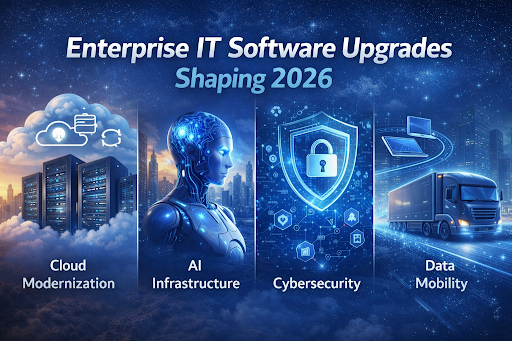
Enterprise IT is entering 2026 with greater momentum and architectural pressure than in any previous year. Artificial intelligence has accelerated data volume and data movement needs. Compliance obligations have expanded globally. Cybersecurity threats are increasingly automated. Hybrid cloud has become the dominant operating model for mid market and large enterprises alike. All of this has driven a wave of software upgrades that are reshaping how organizations manage infrastructure and protect their critical workloads.
This year’s most influential updates come from vendors spanning cloud orchestration, data replication, identity management, observability, backup, storage, automation, and analytics. EnduraData is one of the key players through its EDpCloud 6.3 release, but the broader shift involves an entire ecosystem of suppliers recalibrating their platforms for a hybrid, AI driven era.
The ten updates below represent the releases that will have the most significant effect on enterprise computing in 2026.
Hybrid Cloud Infrastructure Becomes a Real Operating Layer
Hybrid cloud used to be a step between legacy environments and fully cloud native operations. In 2026, it is the foundation itself. Vendors are responding by creating more cohesive platforms that integrate on premise systems, edge devices, and cloud services into unified control layers.
EnduraData’s EDpCloud 6.3 release embodies this convergence with native support for Amazon Snowball Edge and faster AWS S3 synchronization. These features give companies predictable data mobility across offline environments, remote sites, and bandwidth constrained regions. Other vendors are following a similar path by modernizing how identity, governance and storage interact across fragmented environments.
Cybersecurity Shifts to Autonomous Defense and Immutable Recovery
Cybersecurity software entering 2026 has one purpose: to protect. Reduce human reaction time to zero. Vendors have rolled out AI enhanced threat engines, identity centric frameworks, and immutable backup layers that prevent ransomware from compromising recovery operations. Threat actors now target backup systems directly, which is forcing the market to harden every stage of the data lifecycle.
These upgrades highlight that resilience now depends as much on data integrity as on network protections. EnduraData’s ongoing work in ransomware ready replication supports this evolution, ensuring copies remain verifiable and untampered across locations.
AI and Analytics Require Continuous, High Integrity Data Movement
AI adoption has turned data into the new performance bottleneck. Enterprises need real time ingestion, GPU optimized data pipelines and reliable synchronization between edge and cloud systems. Vendors are responding by improving the speed, fidelity, and intelligence of data flow within analytics workflows.
This is where EDpCloud 6.3 and similar tools matter. AI workloads depend on current and complete data sets. Improved S3 throughput and Snowball Edge integration support both online and offline ingestion paths, a feature increasingly important in global and industrial environments.
Compliance Goes From Annual Audit to Always On Process
NIS2, DORA, SEC cybersecurity rules, and global data protection mandates have shifted compliance from reporting to continuous validation. Vendors have updated governance systems with automated evidence collection, tamper resistant audit trails, and integrated continuity checks across cloud and on premise platforms.
These updates reduce compliance burden while also enforcing stronger operational discipline, which is becoming essential for large enterprises, critical infrastructure operators and regulated sectors.
Below is the corrected table with 10 different vendors and 10 important 2026 software updates.
| Software Update | Vendor | Primary Focus | Why It Matters in 2026 |
| EDpCloud 6.3 with Snowball Edge Support | EnduraData | Hybrid replication and edge to cloud data mobility | Enables offline to cloud workflows, AI data pipelines and large scale migrations with predictable performance |
| Azure Arc Distributed Control Suite 2026 | Microsoft | Hybrid cloud governance and identity integration | Extends cloud policy, identity and compliance logic to on premise and edge systems |
| Anthos Platform Update Q1 2026 | Google Cloud | Multi cloud orchestration and service mesh | Simplifies application portability and security across cloud providers |
| Elastic Security 2026 Edition | Elastic | Autonomous threat detection and behavioral analytics | Uses machine intelligence to identify lateral movement and early stage intrusions |
| Veeam Data Platform 2026 | Veeam | Immutable backups and rapid ransomware recovery | Protects storage systems and ensures fast restoration even during sophisticated attacks |
| Red Hat OpenShift 2026 Release | Red Hat | Container orchestration and hybrid application performance | Improves enterprise scale Kubernetes operations and workload portability |
| Datadog Observability Cloud 3.0 | Datadog | Full stack distributed monitoring and telemetry | Offers unified visibility across microservices, serverless workloads and edge nodes |
| Snowflake Arctic Data Engine Update | Snowflake | AI optimized data processing and continuous ingestion | Reduces friction in feeding large models and accelerates analytics performance |
| Cloudflare Zero Trust Suite 2026 | Cloudflare | Identity and access enforcement across distributed users | Provides continuous identity validation for remote and hybrid workforces |
| Pure Storage FlashBlade File Services 2026 | Pure Storage | High performance unstructured data storage | Supports AI pipelines, rapid analytics and large data lake consolidation |
A Clear Pattern: Infrastructure Is Becoming Self Healing and Data Aware
The most strategic software upgrades entering 2026 share several traits. They automate what was once manual. They unify systems that were previously isolated. They enhance visibility across environments that were previously opaque. Above all, they elevate data mobility and data integrity as core components of enterprise resilience.
EDpCloud 6.3 reinforces this pattern. By enabling high speed replication into AWS S3, by supporting offline ingestion through Snowball Edge, and by maintaining cross platform compatibility, it addresses the operational realities of enterprises that straddle physical facilities, cloud services, and remote global footprints.
Where Enterprise IT Is Heading in 2026
The convergence of AI adoption, regulatory tightening and hybrid infrastructure complexity guarantees that 2026 will reward companies that invest in platforms capable of orchestrating, securing, and verifying data across every point of the architecture.
The vendors and updates listed here are not simply feature releases. They represent the foundation for the next generation of enterprise IT: more automated, more interconnected, more intelligent and far more resilient.