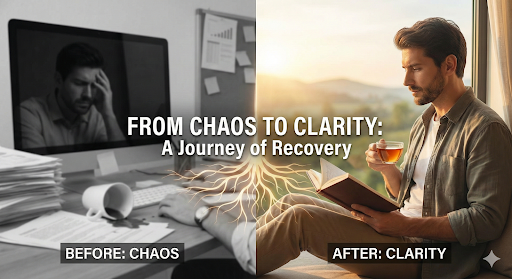
There is a specific kind of arrogance that comes with high-functioning addiction. It’s a delusion that tells you, “As long as the bills are paid, as long as the business is running, and as long as you show up for dinner, you are in control.”
For years, I was the master of this illusion. On paper, I was a success story. I ran a business, I had a beautiful home, and I had a family that loved me. But behind the closed doors of my office—and the even more tightly locked doors of my mind—I was the CEO of Chaos.
I was juggling chainsaws, convinced I was putting on a spectacular show, while in reality, I was slowly bleeding out. The substances I used started as a way to manage stress, a way to get an edge, or a way to unwind. But eventually, they became the fuel required just to get the engine to turn over in the morning.
I was physically present for my wife and children, but spiritually, I was a ghost. I was missing meetings. I was forgetting promises. I was burying my head in the sand, hoping that if I ignored the mounting pile of neglected responsibilities, they would somehow resolve themselves.
It took a Tuesday afternoon—a random, unremarkable Tuesday—for the house of cards to collapse. I looked at a spreadsheet I couldn’t decipher because my brain was too fogged, and I looked at a photo of my family on my desk. I realized I was about to lose both.
The Mirror I Couldn’t Avoid
The decision to seek help didn’t come from a lightning bolt. It came from the quiet, terrifying realization that I had lost the ability to steer my own ship.
I turned to my wife. She knew. Spouses always know, even when we think we are being clever. She had been watching me fade away by degrees for years. When I finally said the words, “I can’t do this anymore,” she didn’t meet me with anger. She met me with a plan.
We didn’t want a band-aid. I didn’t have the luxury of spending 90 days in a talk-therapy rehab only to come out and relapse a week later because the chemical hooks were still in my brain. We needed a hard reset. We needed something that would address the root cause, not just the symptoms.
Through connections to experts in the field of alternative medicine and addiction recovery, the word Ibogaine came up.
I had heard of it—a psychoactive root bark from West Africa used in initiation rituals. But the experts explained it differently. They described it as an “addiction interrupter.” They explained how it resets the brain’s neurochemistry to a pre-addicted state while simultaneously forcing you to confront the psychological trauma driving the behavior.
It sounded terrifying. It sounded like exactly what I needed.
The Journey into the Dark
I flew to a medically supervised clinic [Optional: insert location, e.g., in Mexico or abroad where legal]. I wasn’t going there to party. I was going there to save my life.
The preparation was rigorous. The doctors checked my heart, my liver, and my blood. This is a crucial part of the story that people often miss: Ibogaine is not a recreational trip. It is a serious medical procedure.
When the medicine took hold, the physical sensation was heavy. A buzzing filled the room. And then, the screen of my mind turned on.
They call Ibogaine the “stern father.” It doesn’t coddle you. It doesn’t let you make excuses. For the next several hours, I was forced to watch a slide show of my life. But I wasn’t watching it from my perspective; I was watching it from the perspective of the people I had hurt.
I saw my business partner’s face when I missed that crucial deadline, the stress I had caused him. I saw my wife’s loneliness when I was sitting right next to her on the couch, high and checked out. I saw my own potential being shoveled into a furnace to keep the addiction burning.
It was grueling. There was no place to hide. The medicine stripped away the ego that I had used to protect myself. It showed me that the chaos I was living in wasn’t bad luck—it was my creation. I saw clearly that I was using substances not to feel good, but to avoid feeling the weight of my own neglect.
But then, the tone shifted. After the reprimand came the lesson. I felt a profound sense of forgiveness—not from a deity, but from myself. The message was clear: You have broken things, yes. But you are still here to fix them.
The Grey Fog Lifts
I woke up the next day, and for the first time in a decade, the “noise” was gone.
Anyone who has struggled with substance abuse knows the “noise.” It’s the constant background hum of cravings, anxiety, and calculation. Do I have enough? When can I use next? Will anyone notice?
It was silence. Beautiful, golden silence.
My brain felt scrubbed clean. The physical withdrawals that should have been crippling were non-existent. Ibogaine had reset my dopamine receptors. I was back to baseline.
But the chemical reset was only half the battle. The other half was the realization of what I had to do next. The medicine had opened a window of neuroplasticity—a period where the brain is malleable and ready to learn new habits. I knew I had to act fast.
Accountability as a Love Language
Returning home was surreal. The world hadn’t changed, but I had.
The old me would have tried to jump back into work at 100 miles per hour to “make up for lost time.” The new me understood that was a trap. That was the chaos talking.
Instead, I sat down with my wife and my business partners, and I practiced radical accountability. I admitted where I had failed. I didn’t offer excuses about stress or pressure. I simply owned the neglect.
“I was not present. I endangered our future. I am fixing it.”
The transformation in my business was almost immediate. When a leader stops hiding and starts leading, the energy changes. I began to delegate the things I couldn’t handle and focused on the things only I could do. I implemented systems to keep myself in check.
More importantly, the dynamic at home shifted. My wife got her husband back—not the “high-functioning” zombie, but the man she married. We realized that my recovery wasn’t just about me not taking drugs; it was about us building a life that I didn’t need to escape from.
The Choice to Grow
I am not “cured” in the sense that the work is over. The work is never over. Ibogaine didn’t do the work for me; it simply removed the chains so that I could do the work.
It gave me a choice. Before the treatment, I felt like a passenger in a car with no brakes, careening toward a cliff. Now, I am in the driver’s seat.
If you are reading this and you feel that familiar sense of chaos—if you feel like you are juggling spinning plates and one is bound to drop—I want you to know that there is a way out. But it requires a pivotal decision. You have to be willing to stop the car. You have to be willing to look in the mirror and admit that your way isn’t working.
It might be Ibogaine, it might be something else, but you must find your “hard reset.”
I lost years to the fog. I almost lost my business and my family. But today, I have clarity. I have trust. And for the first time in a long time, when I wake up in the morning, I am not thinking about how to survive the day. I am thinking about how to live it.